.svg.avif)

WELTEC BIOPOWER
builds two biogas plants in Japan
Special plant statics ensure operation in earthquake regions
WELTEC BIOPOWER
builds two biogas plants in Japan
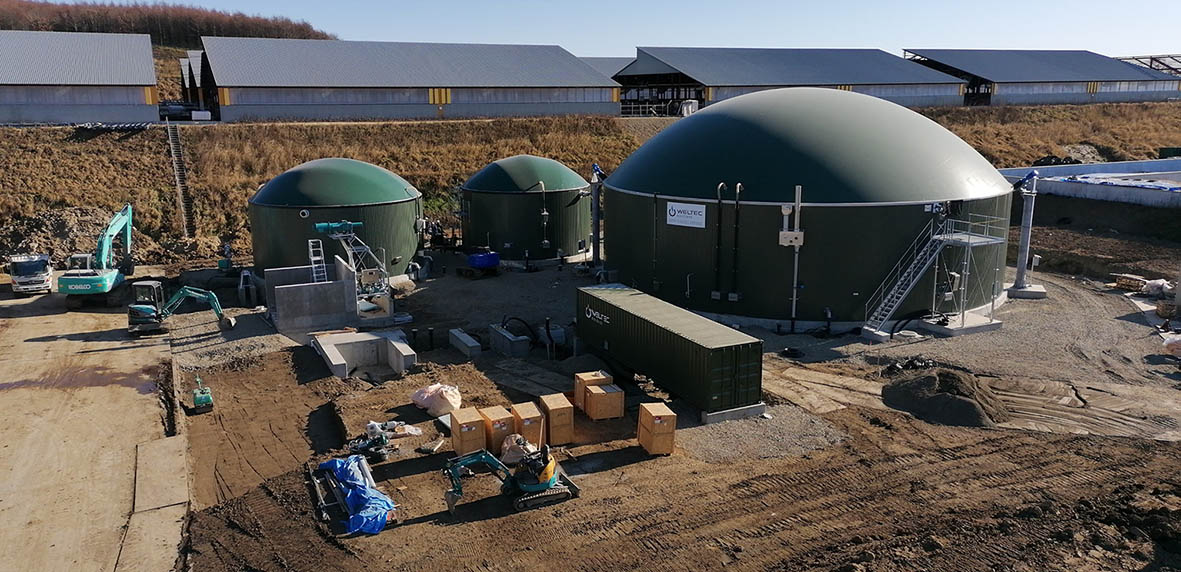
WELTEC BIOPOWER is currently building two 250-kilowatt agricultural biogas plants in Japan for one of the largest milk producers in the island state. One location is in Urahoro, on Hokkaido, the northernmost of the main Japanese islands. The second plant is being built in Sakata (Yamagata Prefecture) on the largest island of Honshu. Both biogas plants are built in earthquake regions and therefore have special statics. The electricity and heat generated are used directly at the sites in order to be energy self-sufficient. In Urahoro, commissioning will take place in summer 2021 and in Sakata in autumn 2021.
Following the Fukushima nuclear disaster in March 2011 and the promotion of renewable energy sources, biogas has a good reputation in Japan. Among renewables, the energy source is regarded as a weather-independent energy source that makes a significant contribution to the required grid stability. However, the conditions for expansion are also favourable because the otherwise resource-poor country has sufficient biomass potential. Efforts to accelerate biogas projects began back in 2002, and shortly after, WELTEC built the first “Made in Germany” plant in Japan. However, the expansion only really got going with the introduction of the state feed-in tariff for green energy in July 2012.
WELTEC's latest biogas projects in Japan include hybrid dairy farms. This means that dairy cows are covered with special beef breeds via embryo transfer and milk and fattening cattle are therefore produced on the farms. Each year, both sites of an agricultural company produce almost 30,000 tons of cattle manure, which is used in biogas plants to generate energy. For efficient fermentation, WELTEC BIOPOWER is building a stainless steel fermenter in Urahoro. WELTEC is building two fermenters in Sakata because animal numbers will be increased there shortly. With a height of 6.30 meters and a diameter of 25.34 meters, all three bioreactors have a capacity of 3,176 cubic meters. The advantage of stainless steel containers is not only the compact shipping in just a few containers from Europe to Japan, but also the easy structural adjustment to earthquake regions.
At the Urahoro site on Hokkaido, the liquid substrates are pumped into the fermenter from three storage facilities. Two of the three warehouses are already in place; however, they are being equipped with the latest technology. The third, 393 cubic meter warehouse is being completely rebuilt by WELTEC. It measures 5.03 meters in height and 9.98 meters in diameter. A pre-camp of this size is also being built in Sakata. Because of the cold and snowy winters, the warehouses at both locations are insulated and equipped with gas-tight double membrane roofs. WELTEC builds a 524 cubic meter container for each fermentation residue. After separation, the fermentation residues are added to our own fields as fertilizer. In addition to the fermenters, pre- and digestate storage, separation and pumping technology, WELTEC BIOPOWER is also installing a 250-kilowatt combined heat and power plant.
Both construction projects are of reference character in Japan due to parallel network operation. The fact that the electricity is not fed in but is used at the plants, for example for milking carousels and other facilities, makes the operator more independent of the power grid. This makes economic sense because network capacity and stability in Japan are threatened, particularly in earthquake areas. Not least because of this, it is advantageous that the framework conditions for the development of bioenergy are favourable: The annual biomass potential in Japan is around 284.4 million tonnes — enough to generate around 13 billion kilowatt hours of electricity and to supply 2.8 million households constantly. The bottom line is that efficient utilization of raw materials in biogas plants such as in Urahoro and Sakata contributes to economic efficiency, environmental compatibility and security of supply and thus to the success of the energy transition in Japan.